

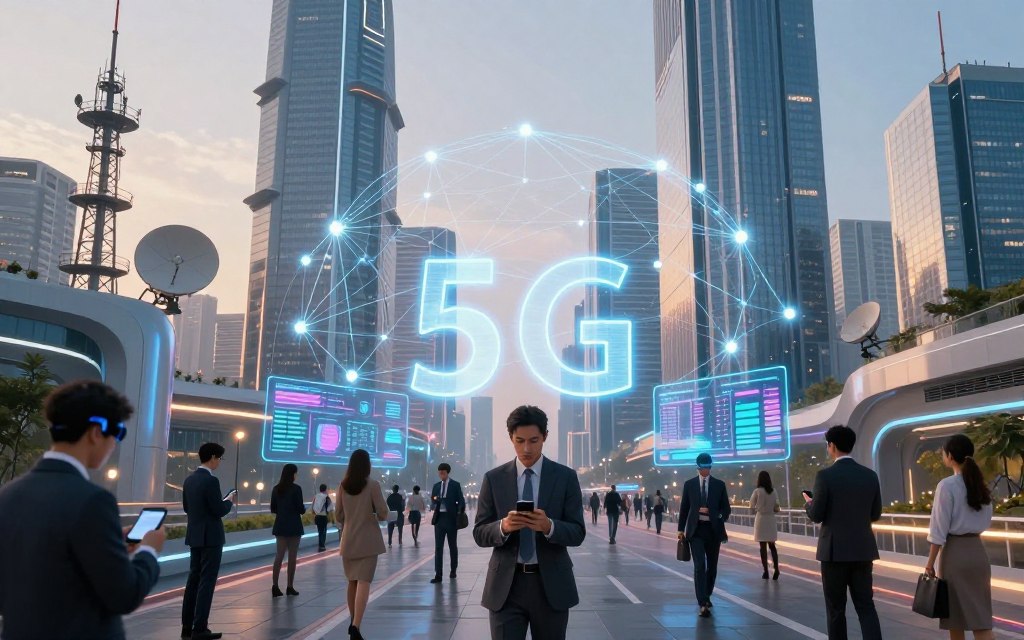
Today, next-generation wireless technology is changing how people connect and communicate. The new 5G network promises more than speed. It combines faster data transfer, lower latency, and support for more devices at once.
Consumers and businesses need to understand how 5G technology works. Data transmission through the 5G network depends on frequency bands and network design. Its benefits are rolling out gradually across the United States and the globe.
5G technology offers more than faster speeds. It adds network flexibility and supports innovative applications. Still, device compatibility and local infrastructure can slow widespread adoption.
Key Takeaways
- 5G enhances data transfer speeds and reduces latency.
- It supports a higher density of connected devices.
- Network performance varies by frequency band and design.
- 5G enables new applications and services for consumers and businesses.
- Adoption challenges include infrastructure and device compatibility.
What Is 5G Technology YouTube and Why It Matters
This guide explains what is 5g technology youtube content often covers. 5G technology is more than an upgrade; it changes how we access information and interact with devices. This fifth generation of cellular networking uses standardized technologies defined by the 3rd Generation Partnership Project (3GPP).
It introduces enhanced mobile broadband, ultra-reliable low-latency communication, and massive machine-type communication. These capabilities can improve user experiences across various applications.
Defining 5G Technology
At its core, 5G technology aims to deliver faster speeds and lower latency. These 5G standards guide the key concepts below. During the 5G rollout, local service can vary.
- Core Technical Standards: These include New Radio (NR), spectrum allocation, network slicing, beamforming, and massive MIMO. Each plays a vital role in ensuring efficient and effective communication.
- Global Deployment Status: The rollout of 5G varies by country, carrier, and population density. Not every location will experience the same level of service, making it essential to understand local availability.
The Role of YouTube in 5G Education
YouTube helps answer what is 5G technology. It offers visual demonstrations that can improve understanding. Videos provide 5G explained content, while a 5G tutorial can make learning more engaging.
- Popular Educational Channels: Look for content from telecom educators, universities, and reputable technology publishers for accurate information.
- Visual Learning Benefits: Videos can clarify complex concepts such as latency, network handoffs, and small-cell placement, making learning more engaging.
The Evolution of Mobile Networks: From 1G to 5G
Mobile networks evolved from early analog voice services to the high-speed data offered by 5G. The journey began with 1G, which mainly provided basic voice communication through analog technology. Users could make calls, but 1G offered little else.
As technology advanced, 2G introduced digital voice services, texting, and better spectrum efficiency. This shift began a new era for mobile network generations, improving security and data performance.
Related Posts:
- Front-End vs. Back-End Technology: How Modern…

- Blue VO!CE Technology Explained: How It Transforms…

- Construction Technology Courses: What You’ll Learn…

- Is mRNA Technology New? The Science and History…

- How to Find Which Technology Used in Website? Your…

- What Are Technology Lanes Understanding Tech Infrastructure

Early Generations (1G to 3G)
3G mobile data brought a major change by enabling mobile internet, email, and multimedia messaging. It made early smartphone services practical, so users could browse the web and download content while traveling. Each transition improved coverage, capacity, and device functions, preparing networks for greater advances.
The 4G Revolution
4G LTE greatly increased mobile broadband speeds and reduced latency, making app services, high-quality streaming, and cloud applications common. Users enjoyed smooth mobile video and location-based tools, changing how they used technology. Although 3G and 4G include several technical standards, advertised speeds often differ from typical user performance.
Overall, the 1G to 5G evolution shows a remarkable journey through cellular technology history. Each generation built on lessons from its predecessor, creating the capacity and efficiency needed in today’s connected world.
How 5G Technology Works
Understanding how 5G works helps explain its potential to transform communication. This advanced mobile network connects devices through a radio access network and sends data through a core network. This network enables smooth access to internet services, private systems, and cloud platforms.
5G uses three frequency bands: low-band 5G, mid-band 5G, and high-band mmWave 5G. Each band affects coverage, building penetration, and bandwidth in different ways.
The Three Frequency Bands
Low-Band 5G
Low-band 5G travels far and penetrates buildings well. However, its added capacity is limited because lower frequencies often face congestion. This band supports wide coverage, especially in rural areas.
Mid-Band 5G
Mid-band 5G balances coverage and speed. It is especially useful in urban and suburban areas, with better performance than low-band 5G and a reasonable range. Its versatility makes this frequency increasingly popular.
High-Band mmWave
High-band mmWave 5G provides extremely high speeds and capacity, but its range is limited. Distance and obstacles, including walls and trees, can weaken its signals. Despite these limits, mmWave 5G serves high-density places like stadiums and urban centers.
Network Architecture and Infrastructure
5G network architecture uses small cells and antennas to improve coverage in busy locations. These cells support larger macro cell sites and strengthen connections where many users gather, such as downtown corridors and airports.
Small Cells and Antennas
Small-cell technology uses spectrum more efficiently and improves overall network performance. With many small cells, operators can provide better service where traditional towers might struggle.
Edge Computing Integration
Edge computing 5G plays a crucial role in modern 5G technology. Placing computing resources closer to users shortens data’s journey and improves responsiveness. This integration supports industrial control, augmented reality, and connected vehicles, making 5G a game-changer for real-time data processing.
Key Features and Capabilities of 5G
5G technology is changing mobile communication with advanced features. This wireless generation offers more than faster downloads and improves many user experiences.
Speed and Latency Improvements
A key 5G speed feature is its remarkable speed. Users get faster downloads and uploads, making high-resolution streaming smooth. This speed also helps cloud services respond quickly.
5G latency measures how long data takes to travel between a device and its destination. Lower 5G latency supports interactive gaming, industrial controls, and remote assistance. In games, it helps players react in real time and enjoy a more immersive experience.
Latency can vary because of server distance, network congestion, and the type of 5G deployment. Therefore, peak results may impress, but typical consumer experiences can differ.
Network Capacity and Reliability
5G capacity improves through wider channels and better radio techniques, helping network capacity grow. These advances let networks serve more devices, especially in crowded areas. This matters as connected devices continue to grow.
5G uses network slicing to divide one physical network into several virtual networks. Each virtual network can meet different performance needs. This flexibility supports basic web browsing and high-demand services.
5G reliability aims to provide steady connections and predictable service. Technologies like massive MIMO improve spectral efficiency. They support more simultaneous connections without reducing performance.
What 5G Changes in Everyday Life
The arrival of 5G is changing 5G everyday life. Better mobile connectivity and smart devices will transform daily technology use. As more networks become available, users will see major improvements in daily routines.
Enhanced Mobile Experiences
With 5G smartphones, users can expect faster app downloads and smoother streaming. Key improvements include:
- Faster App Downloads: Applications that once took minutes to download can now be ready in seconds.
- Clearer Video Calls: Experience high-definition video calls without interruptions, making remote communication more personal.
- Improved Live Streaming: Enjoy live events with minimal buffering, enhancing your viewing experience.
- Responsive Cloud Gaming: Gamers will benefit from reduced lag, allowing for seamless gameplay.
- Quicker File Transfers: Sharing large files is faster, making collaboration easier.
- Better Service in Crowded Venues: Experience reliable connectivity even in busy places like concerts or sports events.
To enjoy these benefits fully, users need a compatible phone, a suitable plan, and a spectrum-supported network. 5G mobile broadband does not replace Wi-Fi; it complements home wireless networks and adds connectivity choices.
Smart Homes and IoT Integration
5G helps develop smart home 5G systems and the Internet of Things (IoT). These systems support many connected devices, including:
- Cameras: Monitor your home with high-definition video feeds.
- Appliances: Control smart refrigerators, ovens, and other devices remotely.
- Sensors: Detect changes in the environment, enhancing security and energy efficiency.
- Wearables: Track health metrics in real-time, promoting a healthier lifestyle.
- Environmental Monitors: Keep an eye on air quality and other important metrics.
Managing many devices is practical with 5G in homes, buildings, and neighborhoods. Yet battery life, device costs, and data security need attention. Many smart-home products still use Wi-Fi, Bluetooth, or other technologies, so 5G joins a broader connectivity ecosystem.
5G Impact on Industries and Business
5G technology is changing industries and business operations. This next-generation connectivity supports better communication, automation, and data management. Organizations see 5G business applications as tools for greater efficiency and innovation.
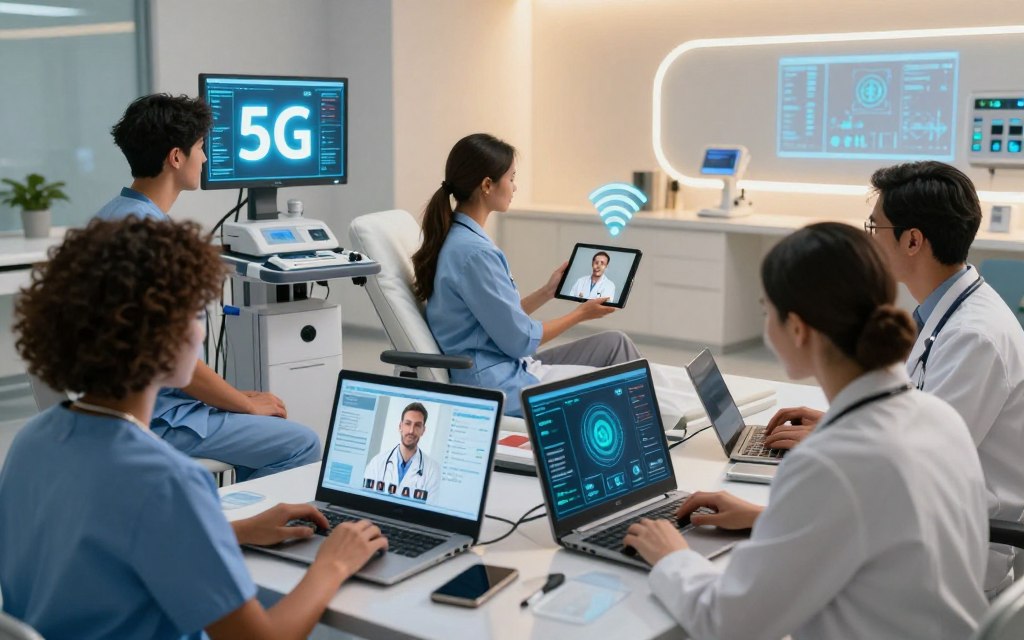
In healthcare, 5G supports telemedicine solutions that improve patient care. Higher-quality video consultations help providers reach patients in remote areas. Connected medical devices monitor vital signs in real time and support timely interventions.
Ambulance connectivity gives medical teams critical information before they reach the scene. Augmented-reality assistance supports surgery, while hospital asset tracking improves efficiency. These 5G healthcare tools cannot ensure safe or suitable remote surgeries.
Safe, effective telemedicine 5G services still require strict rules, strong cybersecurity, and specialized professional training.
Likewise, manufacturing and logistics are advancing through 5G. Smart manufacturing uses industrial IoT sensors to track equipment performance in real time. Automated guided vehicles and robots streamline production, while machine vision improves quality control.
Predictive maintenance reduces downtime by warning about equipment failures before they happen. In logistics, 5G logistics systems support warehouse tracking and fleet coordination, improving supply chain management. Private 5G networks give facilities more control over coverage and data handling, complementing existing Wi-Fi and wired Ethernet solutions.
When adding 5G to business operations, organizations must review several factors. These include total cost of ownership, cybersecurity, workforce training, and return on investment. Businesses should balance 5G’s benefits with practical challenges to improve productivity and drive innovation.
For more technology insights, read this article on emerging trends.
5G vs 4G: Understanding the Major Differences
A 5G vs 4G review helps users make informed decisions about mobile service. Both technologies support mobile connectivity, but they differ in speed, performance, and uses.
During a 4G LTE vs 5G review, 5G can offer higher peak speeds and lower latency than 4G. 5G performance varies with frequency band, coverage, and network congestion. In some areas, 4G LTE may still provide faster and more reliable service, especially when 5G coverage is limited.
Both generations support daily tasks, including browsing, messaging, and video streaming.
4G remains a reliable platform for mobile broadband, while 5G supports new 5G use cases. These 5G use cases include industrial automation, private networks, and massive IoT deployments. The technology also supports connected transportation and immersive media experiences.
During the transition, many networks still rely on 4G infrastructure, so users can switch between technologies seamlessly.
Whether upgrading to 5G is worthwhile depends on device age, local coverage maps, plan pricing, and specific application needs. For more insights, read our detailed 5G and 4G comparison.
Health and Safety Considerations of 5G
As 5G technology spreads, health discussions become more important. Understanding 5G radiation requires careful review of scientific research and regulatory guidelines.
Scientific Research on EMF Exposure
5G uses radiofrequency electromagnetic fields (EMF), a type of non-ionizing radiation. Unlike ionizing radiation, such as X-rays, it lacks enough energy to remove tightly bound electrons from atoms or molecules. This difference helps explain 5G safety.
Safety reviews examine exposure level, frequency, duration, distance, and equipment output. Research shows established biological effects from EMF exposure, but does not conclusively show a significant 5G health risk. However, people should remain cautious and informed.
Device exposure can change with distance, signal conditions, transmission power, and how the device is used. Understanding these factors helps assess possible effects.
Regulatory Standards and Guidelines
National regulators and public health authorities set limits for radiofrequency safety. In the United States, the Federal Communications Commission (FCC) sets FCC 5G guidelines to keep exposure within safe limits. These guidelines use extensive research and aim to protect public health.
People concerned about EMF exposure can take practical precautions. Speaker mode or headphones during calls, and avoiding prolonged close contact with transmitting devices, may reduce personal exposure. These steps are optional risk-management choices, not proof of danger.
For specific concerns about 5G health effects, consult a qualified healthcare professional. Staying informed and making educated choices is the best approach for navigating changing 5G technology.
| Factor | Description | Impact on Exposure |
|---|---|---|
| Distance | Proximity to the source of EMF | Greater distance reduces exposure |
| Signal Conditions | Quality of the signal received | Poor signals may increase transmission power |
| Transmission Power | Power output of the device | Higher power increases exposure |
| Duration | Length of time in contact with the device | Longer duration increases exposure |
Challenges and Limitations of 5G Adoption
5G adoption challenges can slow the move toward widespread service. Although 5G promises faster connections, several barriers make deployment harder.
One major issue involves infrastructure and cost barriers. Carriers may need additional spectrum, fiber backhaul, and upgraded core networks for 5G. New radios, antennas, and small cells are essential for dense urban deployments.
These installations may require complex permits and cooperation with property owners, municipalities, and utilities. Companies must justify 5G investments through subscriber demand, enterprise contracts, or public-sector needs. Device replacement costs and service plans may also discourage consumers and businesses from choosing 5G.
Infrastructure and Cost Barriers
As carriers manage these infrastructure challenges, the financial burden can become daunting. Ongoing maintenance and site leases increase the overall 5G infrastructure cost. Without clear financial incentives, many regions may adopt the technology slowly.
Coverage and Accessibility Issues
Coverage and access issues also complicate the 5G rollout. High-band signals provide better performance but travel shorter distances, requiring many closely spaced sites. Low-band deployment covers larger areas but may provide fewer performance gains.
Rural areas face added challenges, including mountainous terrain and greater distances between sites. These limits deepen the digital divide, as less populated communities may receive upgrades later or have fewer choices.
Public policy, infrastructure sharing, and local permitting can shape equitable deployment. Addressing these factors is essential for broad 5G coverage, including rural 5G service.
| Challenge | Description | Impact |
|---|---|---|
| Infrastructure Costs | High costs for new equipment and installations | Slows down deployment in many areas |
| Coverage Gaps | Inconsistent availability in rural and urban areas | Exacerbates the digital divide |
| Device Compatibility | Need for new devices to utilize 5G | Limits consumer adoption |
The Future of 5G Technology
Anticipating the future of 5G reveals a path filled with new possibilities. Network innovation will improve connectivity and change how we use technology. Several key developments are approaching.
6G and Beyond
Looking beyond 5G, the idea of 6G technology is gaining support. It remains in research and standardization, with goals of intelligent network management and extreme capacity. 6G may combine sensing and communications, creating immersive experiences and better machine-to-machine interactions.
“The future of connectivity depends on advanced technologies that support users and devices.”
Standards, spectrum policy, and energy efficiency will help achieve these goals. Wireless, fiber, cloud, and edge systems must work together to build advanced wireless networks.
Emerging Applications and Innovations
As we explore future 5G applications, many innovations may emerge. Connected vehicles, robotics, and digital twins will reshape industries. Augmented and extended reality will transform entertainment and education.
Precision agriculture and smart infrastructure will improve efficiency and sustainability. Real-time industrial analytics and advanced public-safety communications will become vital as 5G reaches its full potential.
Successful applications require more than high-speed connections. They need dependable devices, compatible platforms, and strong cybersecurity. Clear operational value will support widespread adoption.
Conclusion
5G technology marks a major leap in connectivity, with faster speeds and lower latency. Its flexible platform makes streaming and downloading more efficient. The benefits of 5G also support better operations and innovation in healthcare, manufacturing, and logistics.
The 5G technology impact is significant, but this network has important limits. High deployment costs, uneven coverage, and cybersecurity concerns may affect user experiences. Before upgrading, check local coverage, device compatibility, and your performance needs.
Not every 5G connection provides the same results. Educational resources, including YouTube explainers, help users understand 5G. Always verify technical claims through reputable sources, and use this 5G explained conclusion as a guide.
As the future of connectivity unfolds, staying informed can help you navigate this changing landscape.