

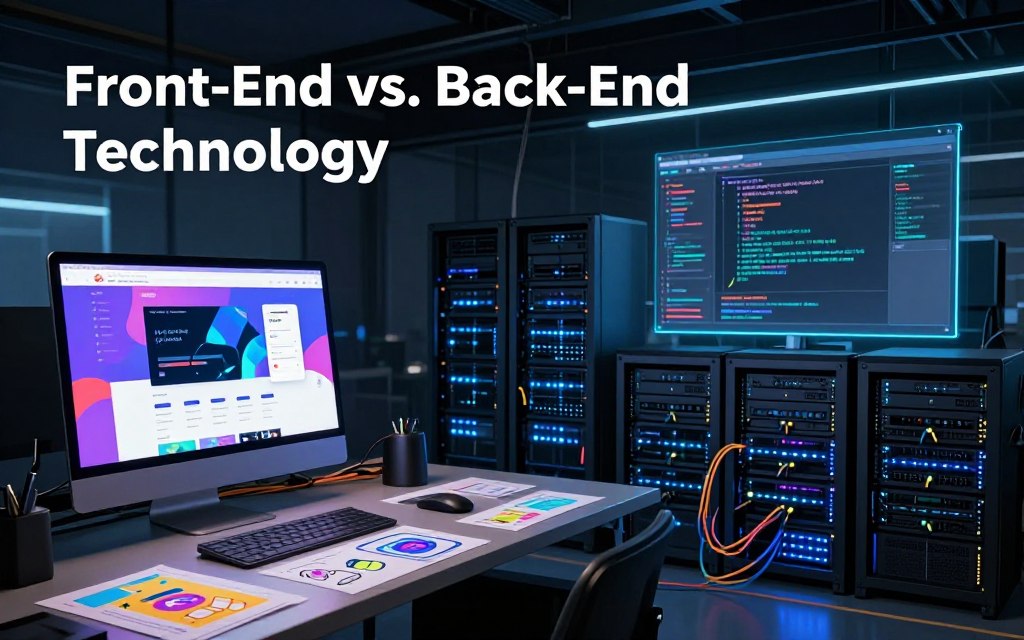
Today’s websites are dynamic platforms, not static pages, and they create engaging experiences. To understand them, we must examine two parts: the browser-facing interface and server-side processes. So, what are front end and backend technologies?
The browser interface, also called the client side, is what users directly see and use. It includes layout, design, and interactive elements that make a site engaging. The server side manages data storage, user authentication, and application logic behind the scenes.
This teamwork explains front-end vs. back-end. When users interact with a site, their browsers send requests to the server. The server processes them, returns needed data, and the client side displays it for a smooth experience.
This article covers HTML, CSS, and JavaScript, plus back-end languages such as Python and Java. It also explores frameworks, databases, APIs, and career paths in web development. Understanding this distinction matters to business owners, aspiring developers, and technical readers.
Key Takeaways
- Modern websites rely on both client-side and server-side technologies.
- The client side is focused on user experience and interface design.
- The server side manages data and application logic.
- Both components must work together for optimal functionality.
- Core programming languages include HTML, CSS, JavaScript, Python, and Java.
- Understanding these technologies is vital for developers and business owners.
What Are Front End and Backend Technologies in Web Development?
Front-end and back-end technologies are the two essential components that make up web development. The front-end technology focuses on what users see and interact with on their devices, including layout, design, and overall user experience. The back-end technology operates behind the scenes, managing the server, database, and application logic.
The front end displays products, shopping carts, and checkout forms. The back end handles inventory management, payment validation, and order processing. This division between the client side and server side supports a smooth web application architecture.
The Two Halves of Modern Web Architecture
Modern web application architecture consists of two halves: the presentation layer and the application layer. The front end, or presentation layer, communicates with the back end, or application layer, to deliver dynamic content to users. This interaction ensures that the user experience is engaging and functional.
Why Understanding Both Sides Matters
Understanding both front-end and back-end technologies helps you evaluate development projects. It helps you choose the right specialists, troubleshoot issues, and understand how a digital product scales. These concepts reveal web development’s complexity and its impact on user satisfaction.
Defining the Front-End: The User Experience Layer
Front-end development shapes the user experience through a website’s design and interactive features. It includes everything users see and use: navigation menus, forms, buttons, typography, images, animations, and responsive layouts. A well-designed user interface engages visitors and helps them move through the site with ease.
Related Posts:
- How to Find Which Technology Used in Website? Your…

- Construction Technology Courses: What You’ll Learn…

- Is mRNA Technology New? The Science and History…

- How Technology Is Useful in the Classroom Enhancing Learning

- What Is a BS in Medical Technology Degree Overview…

- How Technology Is Changing Marketing Trends and Strategies

User interface design and front-end development have different roles. Design focuses on appearance and ease of use, while front-end development makes those plans functional and accessible. Designers and developers work together so websites look good and perform well across devices and screen sizes.
What Users See and Interact With
Visible website elements strongly affect user engagement. The layout should guide users to important information without confusion. Responsive design helps websites fit different screen sizes, creating a seamless experience on mobile and desktop devices.
The Role of Client-Side Rendering
Client-side rendering uses the browser to interpret HTML, CSS, and JavaScript. It builds and updates the web page, enabling fast, app-like interactions after the first JavaScript bundle loads. Poor implementation can hurt performance, accessibility, and search engine crawling.
Front-end developers should use responsive design and conduct thorough cross-browser testing. These steps help browser-based applications provide reliable, accessible experiences on every platform and meet user expectations.
Defining the Back-End: The Server-Side Engine
Understanding the back end shows how websites work beneath the surface. It acts as a server-side engine that powers features users may not see. Back-end development uses web servers, an application server, databases, and authentication systems. Together, these parts handle requests and deliver responses efficiently.
What Happens Behind the Scenes
When users submit login forms or place orders, several processes run behind the scenes. The server receives each request and checks permissions to confirm the user is authorized. Next, it validates inputs to prevent errors or security breaches.
Then it applies business logic, such as calculating shipping costs or checking inventory. Afterward, the server contacts data stores to retrieve or update information. It returns an appropriate response, completing the cycle and creating a smooth website experience.
Server-Side Processing and Business Logic
The back end decides which actions users may take and how systems process information. For example, it can apply discounts based on eligibility or create a personalized dashboard for returning customers. These actions depend on reliable and secure server-side programming.
Back-end systems must be observable and scalable. This matters because they manage sensitive data and support many users at once. These standards help developers meet current needs and adapt to future growth.
| Component | Function | Example |
|---|---|---|
| Web Server | Handles HTTP requests and responses | Apache, Nginx |
| Application Server | Executes server-side logic and processes | Node.js, Tomcat |
| Database | Stores and retrieves data | MySQL, MongoDB |
| Authentication System | Manages user logins and security | OAuth, JWT |
Key Differences Between Front-End and Back-End Development
Understanding the key differences between front-end and back-end development helps people build better websites. Each area has a clear role in creating a smooth user experience. This guide compares front-end vs back-end development, programming languages, tools, and the development environment.
Languages, Tools, and Environments
Front-end development uses HTML, CSS, and JavaScript to build web pages. These programming languages support visual design and interactive features. Browser developer tools and React, Angular, and Vue.js help developers create complex interfaces.
Back-end development uses Python, Java, and PHP for server-side programming. Developers use server frameworks, databases, and API tools to manage data and connect both sides. Cloud infrastructure hosts applications and databases, improving scalability and reliability.
Where the Code Executes
Code execution creates another major difference. Front-end code runs in the user’s browser, supporting immediate interaction. Back-end code executes on remote servers or managed cloud environments, supporting complex processing and data management without directly affecting users.
Performance and Security Considerations
Performance and security matter in both front-end and back-end development. Front-end developers optimize asset size, rendering speed, responsiveness, and accessibility. They improve the user experience by controlling how content loads and displays.
Back-end developers focus on query efficiency, server response times, and scalability. They use authentication and authorization to protect user data. Front-end validation improves usability but cannot replace server-side validation, which protects data integrity and security.
The strongest applications come from coordinated decisions across both layers. A well-rounded approach to web security protects user information, so front-end and back-end developers must work together.
Core Front-End Technologies: HTML, CSS, and JavaScript
HTML, CSS, and JavaScript form the backbone of front-end technologies. Each one helps create engaging, user-friendly websites. Together, they help users see content and interact with it in meaningful ways.
HTML: The Structural Foundation
HTML, or HyperText Markup Language, is the structural foundation of web pages. It defines content and layout through headings, paragraphs, links, forms, lists, and images. Using semantic HTML improves access and SEO; <header> and <footer> show content purpose to search engines.
CSS: Styling and Visual Design
Cascading Style Sheets (CSS) bring websites to life through visual design. They control layout, colors, typography, and overall appearance. Flexbox and Grid help developers create responsive designs for different screen sizes.
CSS also supports animations and transitions, making interactions more engaging. Using responsive CSS helps websites look great on every device and gives users a smooth experience.
JavaScript: Interactivity and Dynamic Behavior
JavaScript adds interactivity to web pages, making them dynamic and responsive to user actions. It can update content without refreshing pages, validate inputs, and retrieve data from APIs. This power helps create modern web applications that feel alive and engaging.
JavaScript enables JavaScript interactivity, turning static content into engaging experiences.
HTML, CSS, and JavaScript are complementary tools, not standalone technologies. Together, they create effective web experiences. Aspiring front-end developers should learn each technology, browser compatibility, progressive enhancement, and performance optimization to make applications functional and enjoyable.
Popular Front-End Frameworks and Libraries
Front-end frameworks and libraries shape modern web development. They help developers build complex user interfaces more efficiently. They organize code, reuse components, and manage state.
React: Component-Based User Interfaces
React is a popular JavaScript library for building reusable components. Its declarative approach helps developers design interactive user interfaces. Its broad ecosystem supports React development for simple dashboards and large consumer platforms.
Angular: Enterprise-Grade Applications
The Angular framework offers a complete solution for structured, large-scale applications. Built-in features include dependency injection, routing, and form management. TypeScript also improves code quality and long-term maintenance.
Vue.js: The Progressive JavaScript Framework
Vue.js is an approachable, flexible choice for developers. It can improve a small page or power an entire application, so it fits many projects. When choosing a framework, consider the learning curve, team experience, and long-term maintenance needs.
Choose a front-end framework that matches business goals and application complexity. Each framework offers unique benefits for component-based UI work. Understanding these differences helps teams make informed decisions.

Core Back-End Programming Languages
Strong web apps need a clear understanding of back-end programming languages. Each language has different strengths, so projects need different tools. Knowing these options helps developers choose tools for their needs.
Python: Versatility and Readability
Python has readable syntax and broad uses, so many developers choose it. It has strong community support and supports Python web development. Its powerful libraries and frameworks, including Django and Flask, support automation and data applications.
Java: Enterprise Reliability and Scale
Java remains a trusted back-end language. Its mature ecosystem and portability support Java enterprise applications. Its performance and tools suit large organizations and systems with many transactions.
JavaScript with Node.js: Unified Development
Node.js lets developers use JavaScript on the server. Teams can share language skills across the stack, improving communication and productivity. Node.js works especially well for building event-driven applications.
PHP, Ruby, and C# in Server-Side Development
PHP remains important for server-side work, especially content management systems and web hosting. Ruby uses productive conventions and Rails to speed development. C# works smoothly with .NET, making it a strong choice for enterprise environments.
| Language | Strengths | Common Use Cases |
|---|---|---|
| Python | Readability, strong community | Web development, data science |
| Java | Portability, performance | Enterprise applications |
| Node.js | Unified development, event-driven | Real-time applications |
| PHP | Content management | Web hosting |
| Ruby | Productivity, Rails ecosystem | Web applications |
| C# | Integration with .NET | Enterprise solutions |
When choosing back-end programming languages, consider team skills, libraries, hosting options, security support, scalability, and project needs. Every language has a useful role in development. Knowing their differences supports better decisions.
Back-End Frameworks and Server Technologies
Back-end frameworks give developers reusable structures for building robust applications. They streamline routing, request handling, authentication, validation, database access, error management, and testing. These tools let developers build features without reinventing each process for every project.
Django and Flask for Python
Django and Flask are two prominent Python frameworks with different strengths. Django follows a batteries-included philosophy with an admin panel, Object-Relational Mapping (ORM), and strong security conventions. It suits developers seeking a complete solution out of the box.
On the other hand, Flask is a lightweight, extensible framework that lets developers choose their components. Its minimal approach suits smaller applications and developers who value flexibility over many built-in features. This contrast helps developers select the best tool for their specific needs.
Express.js for Node.js Applications
Express.js is a minimal and flexible framework for Node.js. It helps developers efficiently create routes, middleware pipelines, APIs, and web services. Its middleware can handle logging, authentication, and error responses with ease.
This modular design supports scalable, maintainable applications.
Spring Boot for Java Environments
Spring Boot simplifies Java application development through automatic configuration and production-ready features. It works smoothly with the broader Spring ecosystem, easing dependency management and application deployment. Spring Boot also supports various server technologies, including reverse proxies and containerization, which improve performance and scalability.
These frameworks improve consistency and reduce development time, but they cannot replace sound architecture. Developers still need secure coding, thorough testing, and ongoing maintenance. They must stay vigilant to keep applications secure and efficient.
In summary, back-end frameworks such as Django, Flask, Express.js, and Spring Boot provide essential structures for server-side applications. By understanding each framework’s advantages, developers can choose tools that meet project requirements effectively. For further insights into front-end and back-end technologies, visit this resource.
Databases and Data Management in Back-End Development
Databases in web development support back-end systems by storing essential application data. They handle user accounts, product catalogs, transactions, messages, and activity records. Knowing database types helps developers choose the right option for each project.
Relational Databases: MySQL and PostgreSQL
Relational databases organize data in structured tables. Rows show individual records, while columns show data attributes. Relationships between tables support complex queries with SQL.
MySQL is a popular relational database used widely for web hosting and applications. It is known for speed and reliability. PostgreSQL offers advanced SQL, extensibility, and strong data integrity for complex applications.
NoSQL Databases: MongoDB and Redis
In SQL vs NoSQL choices, NoSQL databases store data in flexible formats. MongoDB uses documents, making unstructured data easier to manage. Redis uses in-memory data structures for caching, sessions, queues, and fast lookups.
Choosing the Right Database for Your Project
When choosing a database, consider data relationships, consistency needs, and transaction requirements. Review your application’s read and write volume, reporting needs, and operational expertise. Real-world systems may use multiple data stores, but each added technology increases complexity and needs a clear purpose.
| Database Type | Examples | Best Use Cases |
|---|---|---|
| Relational | MySQL, PostgreSQL | Structured data, complex queries |
| NoSQL | MongoDB, Redis | Unstructured data, high-speed transactions |
| Hybrid | Various combinations | Complex applications requiring flexibility |
How Front-End and Back-End Work Together: APIs and Communication
Front-end and back-end technologies form the backbone of every web application. APIs in web development support front-end back-end communication. Application Programming Interfaces let the front end request data and send information to the back end, creating a smooth user experience.
RESTful APIs: The Industry Standard
RESTful APIs are widely used in web development. A RESTful API follows clear principles that make it easy to use and understand. Its key components include:
- Resources: Each API endpoint represents a resource, such as a product or user.
- HTTP Methods: Common methods include:
- GET: Retrieve data
- POST: Create new resources
- PUT: Update existing resources
- PATCH: Partially update resources
- DELETE: Remove resources
- Status Codes: These codes inform the client about the result of their request, such as 200 for success or 404 for not found.
- JSON Responses: Data is often returned in JSON format, making it easy to parse.
- Authentication: Secure APIs require authentication methods to protect data.
- Endpoint Design: Well-structured endpoints improve usability and maintainability.
For example, an online store uses a RESTful API to request product data from the server. The front end also sends order details for processing.
GraphQL: Flexible Data Queries
GraphQL offers a flexible alternative to RESTful APIs. Clients use a defined schema to request only needed data, reducing data transfer and improving performance. However, it adds concerns involving caching, authorization, and query complexity.
- Caching: Managing cached data can be more complex.
- Authorization: Ensuring proper access controls is critical.
- Query Complexity: Clients can request complex data structures, which may affect performance.
The Request-Response Cycle Explained
The request-response cycle explains front-end back-end communication. It shows how user actions become server responses:
- A user action triggers front-end code.
- The browser creates an HTTP request.
- The server routes and validates the request.
- Business logic interacts with a database or service.
- The server returns a response that the interface renders.
Throughout this cycle, error handling, loading states, retries, and timeouts matter. CORS, HTTPS, and API versioning also matter. Together, these elements support communication quality, user experience, and system reliability.
Career Opportunities in Front-End and Back-End Development
Exploring web development reveals many career paths for aspiring professionals. The digital landscape keeps changing, increasing demand for skilled developers. This section covers roles and key skills for front-end, back-end, and full-stack developers.
Front-End Developer Roles and Required Skills
A front-end developer career focuses on a website’s visual elements. Key skills include:
- HTML, CSS, and JavaScript: The foundational languages for building web interfaces.
- Responsive Design: Ensuring websites work well on various devices.
- Accessibility: Making sites usable for all individuals.
- Browser Tools: Utilizing developer tools for debugging and performance optimization.
- Version Control: Managing code changes effectively.
- Collaboration: Working closely with designers and product teams.
Back-End Developer Roles and Required Skills
Back-end developers manage server-side logic and databases. Essential back-end developer skills include:
- Server-Side Programming: Languages like Python, Java, or Node.js.
- API Design: Creating interfaces for front-end and back-end communication.
- Databases: Knowledge of SQL and NoSQL databases.
- Security: Implementing authentication and data protection measures.
- Deployment and Monitoring: Ensuring applications run smoothly in production.
Full-Stack Developer: The Hybrid Professional
A full-stack developer works across front-end and back-end layers. A full-stack developer need not master every technology equally. They need broad system knowledge and deeper skill in specific areas.
- An accessible product site
- An authenticated dashboard
- An API-connected application
Practical portfolio projects can include an accessible product site, an authenticated dashboard, and an API-connected application.
Git, documentation, communication, debugging, code review, and continuous learning are valued across all roles. These software engineering skills matter across web development jobs. Job titles and duties can vary by company, product size, and engineering team structure.
Conclusion
Understanding front-end and back-end technologies is vital to modern web development. These distinct layers form the backbone of web application technology and depend on each other. The front end uses HTML, CSS, and JavaScript; the back end manages data, security, and business logic.
Website architecture plays a vital role in front-end and back-end integration. APIs enable smooth communication and request-response cycles, helping deliver robust, efficient applications. Choose React, Angular, Python, or Node.js based on project needs, not current trends.
Learning the fundamentals of front-end and back-end development sets the stage for success. Practical projects deepen your understanding of how interfaces interact with servers and databases. This hands-on experience will improve your skills and prepare you for a career in this changing field.